
Halifax County Court Records After Arrest
The arrest-to-court path in Halifax County runs through separate record systems. The jail record is created when someone is booked into the Halifax County Detention Center. The court record is maintained by the North Carolina Judicial Branch. The Judicial Branch Halifax page identifies Prosecutorial District 7, Superior Court District 7A, and District Court District 7, and it reports that eCourts is live for Halifax County as part of Track 8.
A jail profile can help start the court search because the Halifax roster charge table includes court type and court date. It is still not the formal docket. Booking charges can be amended, reduced, dismissed, or superseded once the District Attorney reviews the case. For custody and booking details, use Halifax County jail inmate records. For booking photos, use Halifax County jail mugshots. For filed court charges and case status, search the Judicial Branch systems.
Search Court Records After Arrest
The main online route is the North Carolina eCourts Portal. The Halifax Judicial Branch page routes users to court dates, criminal calendars, forms, and eCourts links. Portal tools include Smart Search, Search Hearings, Make Payments, and NC Judgment Search. Anonymous access exists, but the research notes that CAPTCHA and JavaScript are required.
- Start with the jail profile to get the name, charge wording, court type, and court date.
- Open the NC eCourts Portal and choose Smart Search for case information.
- Search by defendant name or case number if a case number is known.
- Use Search Hearings when the immediate need is a court date or hearing.
- Compare court charges with jail charges because the prosecutor may change the case after booking.
- Contact the Halifax County Clerk of Superior Court at 252-593-3000 if the portal does not answer the question.
The manifest image below comes from the NC eCourts Portal, which is the court-side search path for Halifax County criminal cases.
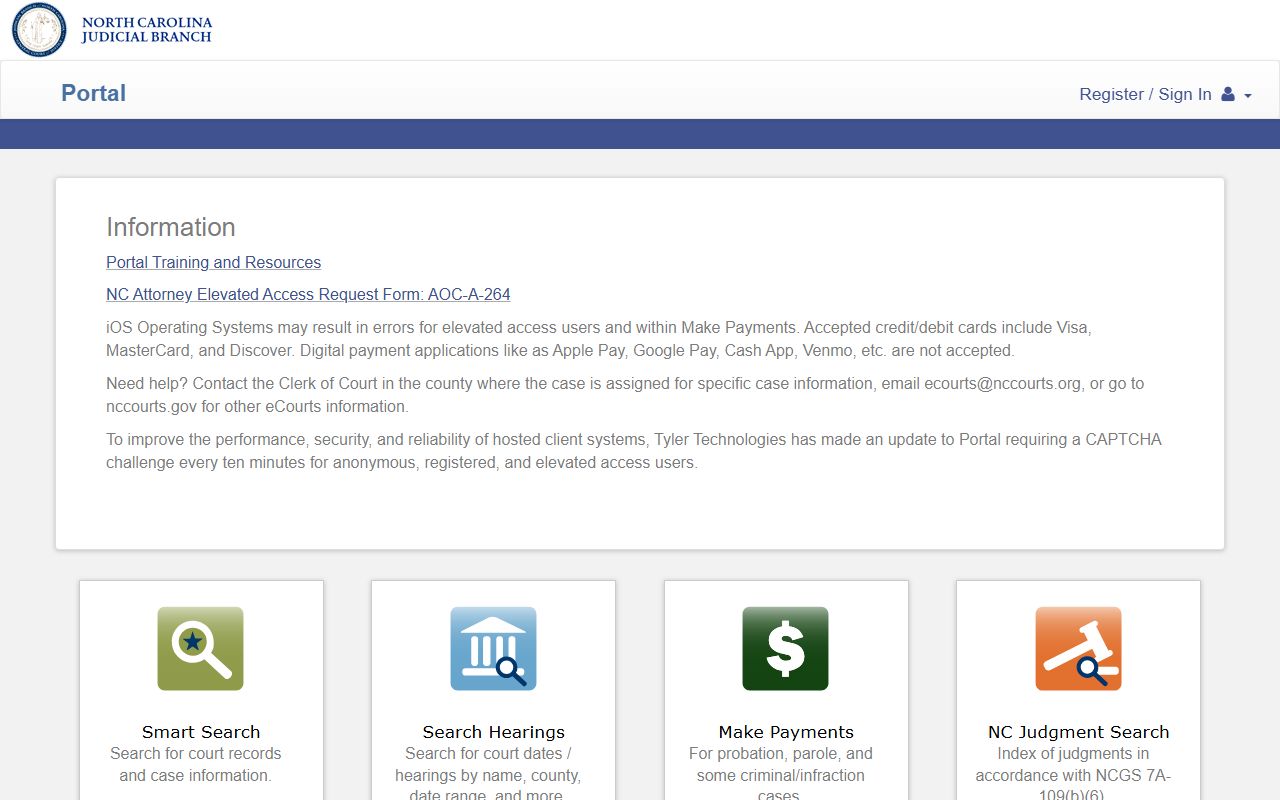
The portal screenshot belongs here because the court record search begins outside the jail roster after arrest and booking.
Halifax County Court Search Fields
The eCourts Portal has separate tools for case records, hearings, payments, and judgments. That structure matters because a person may need the filed charge record, a next hearing date, or a payment function. The portal is not a jail roster, so it should be searched after collecting arrest and booking facts from the detention-center profile.
| Portal Feature | Type | Use | Notes |
|---|---|---|---|
| Smart Search | Case search | Court records and case information | Search by name or case number where available. |
| Search Hearings | Hearing search | Court dates and hearing schedules | Search by name, county, date range, and related filters. |
| Make Payments | Payment card | Payments in eligible matters | Accepted cards include Visa, MasterCard, and Discover. |
| NC Judgment Search | Judgment index | Judgments under G.S. 7A-109(b)(6) | Different from a jail booking search. |
| Register / Sign In | Account access | Optional depending on access need | Anonymous and registered users face CAPTCHA requirements. |
Charges Filed After Arrest
After an arrest, the jail may display the initial charge text while the prosecutor decides how the State will proceed. Halifax County is in Prosecutorial District 7 with Bertie, Hertford, and Northampton counties. The North Carolina Conference of District Attorneys page names Kim Scott as District Attorney for the Seventh Prosecutorial District. The DA represents the State in court proceedings against people accused of crimes.
| Document | Who Uses It | Plain Meaning |
|---|---|---|
| Complaint | Officer or prosecutor | Starts many criminal matters with a written accusation. |
| Information | Prosecutor | A prosecutor-filed charging document used in some cases. |
| Indictment | Grand jury | A formal felony accusation returned by a grand jury. |
North Carolina criminal cases can move between District and Superior Court. The Halifax jail profile sample showed both District and Superior court rows. That means a reader should not assume one booking line is the final version of the case.
Halifax County Charge Status
Charge status terms explain what happened after arrest. They are not the same as custody status. A person can be released from the Halifax County Detention Center while a court case remains pending, and a person can have a court charge dismissed while an older booking record still appears in some local or historical record path.
| Status | What It Means |
|---|---|
| Pending | The case is open and unresolved. |
| Amended | The charge wording or statute changed. |
| Reduced | The prosecutor or court changed the charge to a lesser offense. |
| Dismissed | The charge was ended without a conviction. |
| Indicted | A grand jury returned a formal felony accusation. |
| Disposed | The case has a final result. |
| Convicted | A guilty plea, verdict, or other conviction entry exists. |
Bond After Halifax County Arrest
The Halifax jail FAQ says charge and bond information can be obtained from the jail at 252-583-3081 with the inmate's full name. For release requirements, it directs the public to the Halifax Magistrate's Office at 252-593-3019 or to a bail bondsman. The inspected roster profile displayed bond at the charge-row level, so one person can have more than one bond amount or bond type.
| Bond Term | How It Works |
|---|---|
| Secured bond | Cash, property, or a bail-agent surety is required before release. |
| Unsecured bond | Release can occur without paying upfront, but payment may be owed after a violation. |
| Written promise / PR | Release is based on a written promise to appear. |
| No-bond hold | Simple payment will not release the person because of a court order, hold, or other legal reason. |
| Detainer | Another agency has a hold or notice that may affect release. |
Warrants and Court Records After Arrest
No official Halifax County Sheriff's Office active-warrant search page was located in the researched sheriff navigation. If a warrant has already led to arrest and booking, the person may appear in the jail roster. For warrant questions that have not led to a booking, use the Magistrate offices, Clerk of Superior Court, Sheriff's Office, eCourts Portal, and public-record request channels.
- Arrest warrant
- A judicial command to arrest a person based on a charge.
- Bench warrant or order for arrest
- Often issued after failure to appear or violation of a court order.
- Search warrant
- Authorizes a search and is not the same as an arrest warrant.
- Fugitive or probation hold
- Can keep a person in custody even when a local charge has a bond.
Halifax County Court Contacts
The Judicial Branch contact directory and DA page provide several court-side contacts. Use the Clerk of Superior Court for court file and case-status questions, the District Attorney for prosecution-side matters, and the Magistrate for release requirements. The district DA office page gives a district-wide office number, while the Judicial Branch directory lists a Halifax courthouse DA line.
Halifax County Courthouse
357 Ferrell Lane
Halifax, NC 27839
252-593-3000
Clerk of Superior Court
Halifax County Courthouse
Halifax, NC
252-593-3000
District Attorney
Halifax courthouse line
District 7
252-593-3010
Magistrate, Halifax
Release requirements
Halifax, NC
252-593-3019
Charges vs Convictions
An arrest and charge are not the same as a conviction. A charge is an accusation or formal allegation. A conviction comes later through a guilty plea, verdict, or other conviction entry. This distinction is central when reading Halifax County court records after a jail arrest because early jail charges can change before final disposition.
| Charge | Conviction | |
|---|---|---|
| Stage | After arrest or prosecutor filing | After plea, verdict, or conviction entry |
| Meaning | An accusation that has not been proven | A court outcome showing guilt or conviction status |
| Where to confirm | eCourts, Clerk, prosecutor updates | Final court disposition and judgment records |
Sealed and Expunged Records
North Carolina expunction rules can affect public court records after an arrest. G.S. 15A-146 addresses expunction of dismissed charges and findings of not guilty under listed conditions. G.S. 15A-153 addresses the effect of expunction and clearing the public record. The Judicial Branch also has an expunction help topic.
| Sealed | Expunged | |
|---|---|---|
| Public visibility | Hidden or restricted from public view | Removed or treated as cleared under the order |
| How it happens | Court order or statute | Court process under North Carolina expunction law |
| Best source | Clerk or Judicial Branch guidance | Judicial Branch expunction process and statute |
Important: Do not use casual arrest or court lookups for employment, tenant, credit, insurance, or other FCRA-covered screening.